
1.1 Scope of the course
Type 1 diabetes is an autoimmune disease in which pancreatic beta-cell function becomes insufficient to maintain normal glucose regulation. Insulin therapy replaces an essential hormone, but it does not reproduce every function of the pancreatic islet or remove the underlying immune process.
Research on curative therapies therefore spans several fields. Cell biology addresses the production of functional beta cells. Immunology addresses recurrent autoimmunity and rejection of transplanted cells. Transplantation and biomedical engineering address oxygen delivery, implantation, monitoring, manufacturing, and long-term safety. Clinical research determines whether a proposed treatment produces a meaningful benefit in people and at what cost or risk.
The course begins with normal glucose regulation because each therapeutic approach can be evaluated partly by how closely it restores that physiology. Later chapters examine disease mechanisms, current treatment, beta-cell replacement, stem-cell differentiation, gene editing, immune modulation, and human evidence.
1.2 Glucose as a regulated fuel
Human cells require usable sources of energy. Glucose is a small fuel molecule transported in blood from the intestine or liver to tissues throughout the body.
The phrase blood sugar is everyday language for blood glucose. It does not mean that sugar is simply “bad.” The brain depends heavily on a continuous fuel supply, and red blood cells depend on glucose. The problem is concentration: too little is immediately dangerous, while too much for too long slowly injures tissues.
This is why the goal is not “make glucose as low as possible.” The goal is a safe operating range. Severe low glucose can rapidly impair thinking, cause seizures, or lead to unconsciousness. Persistently high glucose damages blood vessels, nerves, kidneys, eyes, and other tissues over years.
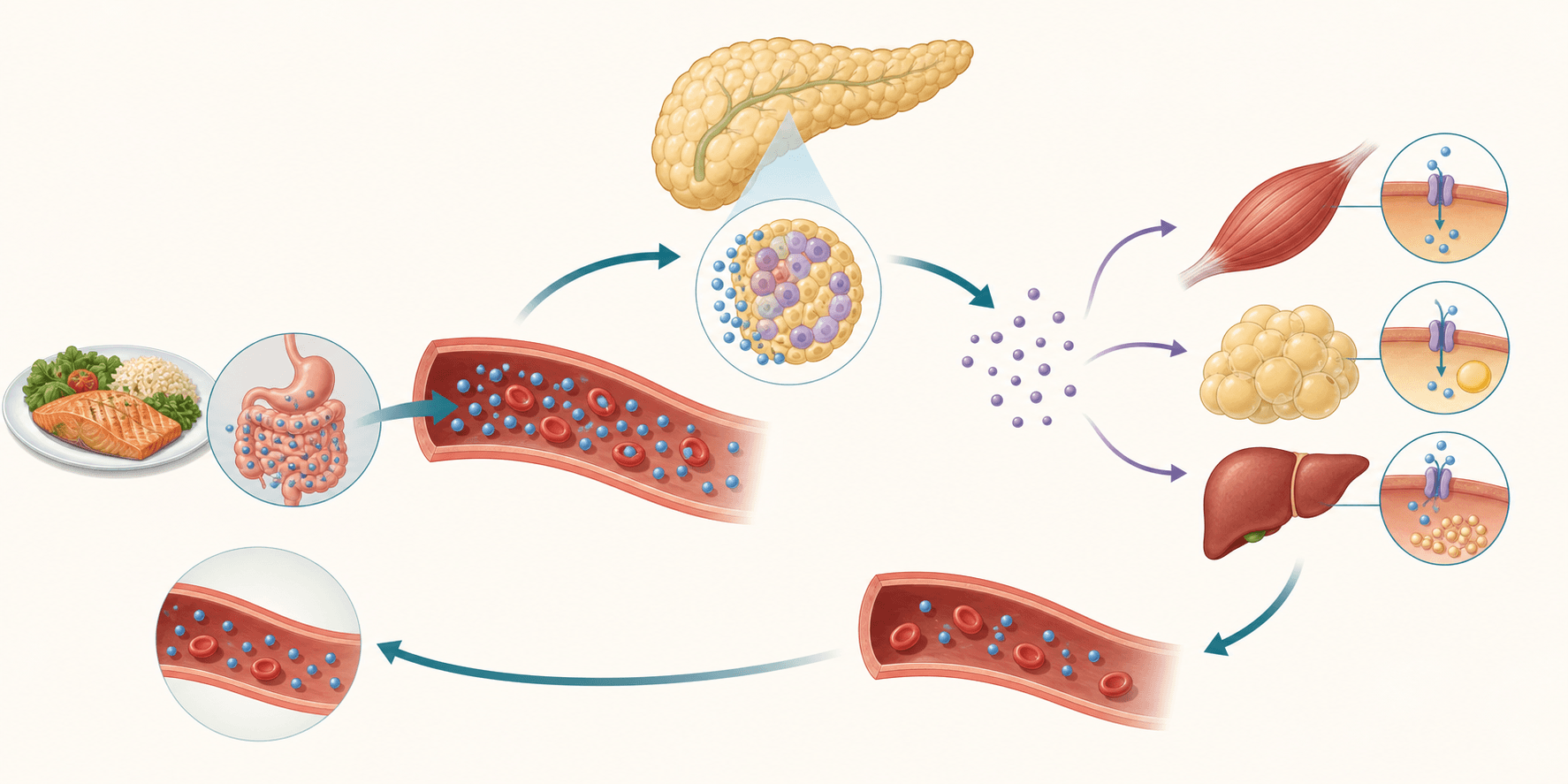
The glucose feedback loop
- 1
A meal raises blood glucose
- 2
Beta cells sense the rise
- 3
Insulin secretion increases
- 4
Liver, muscle, and fat store or use glucose
- 5
Blood glucose falls
- 6
Insulin secretion falls
1.3 Regulation after a meal
After a carbohydrate-rich meal, digestion converts much of the starch to glucose. Glucose crosses the intestine and enters blood that flows first toward the liver, increasing blood glucose.
Tiny cell clusters in the pancreas called islets sample that changing blood. Their beta cells do not need a person to count carbohydrates or press a button. They detect the chemical change directly.
From bite to beta-cell response
- 1
Digestive enzymes break starch into smaller sugars, including glucose.
- 2
Glucose enters the bloodstream from the intestine.
- 3
Beta cells take up and metabolize glucose, increasing their internal energy supply.
- 4
That energy change closes ATP-sensitive potassium channels in the beta-cell membrane.
- 5
The membrane voltage changes, calcium enters, and insulin granules fuse with the cell surface.
- 6
Insulin is released into blood within minutes of the rising glucose signal.
The channel and voltage details may sound advanced, but the logic is simple: glucose changes beta-cell metabolism; metabolism changes an electrical switch; the switch releases insulin.
1.4 Metabolic effects of insulin
Insulin acts on several organs at once:
- Liver: make less new glucose, stop releasing as much stored glucose, and build glycogen.
- Muscle: take up more glucose and store some as glycogen for later work.
- Fat tissue: store energy and reduce the release of fatty acids.
The liver deserves special attention. During the night, it releases glucose so the brain does not run out of fuel. After a meal, insulin tells it to slow that output. If insulin is absent, glucose can rise not only because food is entering blood, but because the liver is still adding more.
As insulin’s message takes effect, blood glucose falls toward its starting range. The beta cell now receives less stimulation, so insulin secretion falls. The correction switches itself off.
That is negative feedback: the response opposes the original disturbance. “Negative” does not mean harmful. It means that the output pushes the system back toward its target.
Concept questionWhat would happen if insulin stayed high after glucose had already returned to normal?
Explanation
Tissues would keep removing glucose and the liver would keep suppressing its own glucose output. Blood glucose could fall too far. A useful controller must know when to stop as well as when to start.
1.5 Glucagon and fasting regulation
Insulin is only half of the story. When glucose is falling or a person is fasting, alpha cells in the islet release glucagon. Glucagon tells the liver to break down glycogen and make more glucose.
Insulin and glucagon provide two coordinated signals:
Insulin
The fed-state signal: store fuel, use incoming glucose, and reduce liver glucose output.
Glucagon
The fasting-state signal: release stored fuel and defend against glucose falling too far.
Adrenaline, cortisol, and growth hormone can also raise glucose or reduce insulin sensitivity in particular situations. Exercise, infection, stress, sleep, and menstrual cycles all change the problem the controller must solve.
1.6 Physiologic and subcutaneous insulin delivery
Natural insulin leaves the pancreas through the portal vein, which carries it to the liver before the rest of the body. The liver therefore sees a strong insulin signal early. Injected or pumped insulin enters the tissue under the skin, reaches the general circulation gradually, and gets to the liver by a different route.
External insulin is life-saving and can produce excellent control. But it has unavoidable constraints:
- absorption takes time and varies;
- a dose already absorbed cannot be taken back;
- the dose must anticipate food, exercise, illness, and other changes;
- it replaces mainly one hormone in a multi-hormone system.
Review questions
Review the chapter concepts.
- Why is healthy glucose control about a range rather than making glucose as low as possible?
- Explain why insulin secretion is part of a negative-feedback loop.
- Why can high glucose occur from both a meal and continued liver glucose output?
- What is the difference between insulin as a hormone signal and glucose as a fuel?
- Name two reasons injected insulin cannot perfectly reproduce beta-cell physiology.
Use these questions to identify concepts that require additional review.