
7.1 One genome, many cell identities
Nearly every cell in the human body contains essentially the same DNA. Neurons, liver cells, and beta cells differ because different sets of genes are active, accessible, or repressed.
A pluripotent stem cell can self-renew and can, under the right conditions, give rise to nearly all adult cell types. Pluripotency is a capacity, not a finished therapeutic identity.
There are two major starting sources:
- Embryonic stem cells are derived from an early embryo and can form renewable cell lines.
- Induced pluripotent stem cells (iPSCs) are mature cells reprogrammed back into a pluripotent state.
7.2 Differentiation follows developmental order
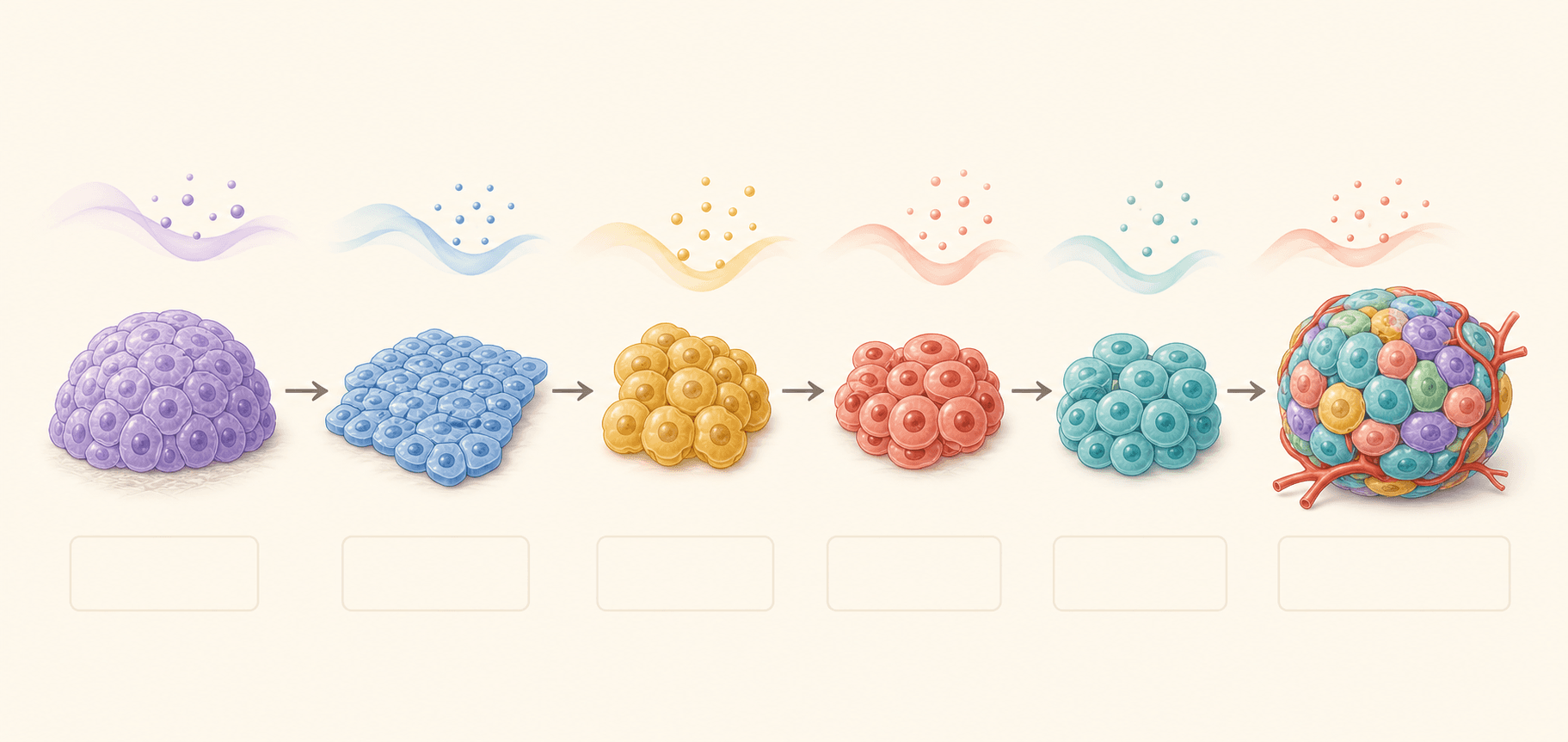
Researchers cannot reliably turn a stem cell into a mature beta cell with one final “make insulin” command. During embryonic development, cells receive signals in a sequence. Each stage narrows the range of identities the cell can still become.
Stages of directed islet-cell differentiation
- 1
Pluripotent stem cell
- 2
Definitive endoderm
- 3
Pancreatic progenitor
- 4
Endocrine progenitor
- 5
Beta-like cell
- 6
Mature islet-like cluster
Laboratory protocols imitate that sequence. A typical route passes through:
- definitive endoderm, the embryonic lineage that produces pancreas and gut;
- pancreatic progenitors, committed toward pancreatic tissue;
- endocrine progenitors, poised to become hormone-secreting cells;
- beta-like and other islet endocrine cells;
- more mature, organized islet-like clusters.
A signal that is useful on day three may be harmful on day ten. Concentration, timing, medium, cluster size, physical substrate, oxygen, and handling all matter.
7.3 The final product is a population
A batch is not made of millions of perfectly identical beta cells. It contains a distribution of cell states. Researchers ask:
- What fraction has the intended endocrine identity?
- Are alpha and delta cells present in useful proportions?
- Are there off-target cells?
- Do any undifferentiated pluripotent cells remain?
- Do cells secrete insulin at low glucose, or only when glucose rises?
- Are chromosomes and edited DNA stable after expansion?
- Does the batch survive freezing, shipping, and implantation?
Residual pluripotent cells are especially concerning because uncontrolled differentiation can create unwanted tissue or tumors. Manufacturing therefore includes purification, release testing, and long-term safety strategies.
7.4 Cell banks make scale possible
An allogeneic strategy starts from a deeply characterized master cell line. Manufacturers expand it, create working banks, differentiate large batches, test them, freeze doses, and distribute a standardized product. This resembles off-the-shelf manufacture, although living cells remain far more complex than tablets.
An autologous strategy starts with cells from each patient, reprograms them, differentiates them, and returns them to the same person.
Allogeneic
One standardized donor-derived line can supply many patients. It supports scale but creates donor-recipient immune mismatch.
Autologous
Cells are patient-specific and reduce donor mismatch. Manufacture is slower, bespoke, expensive, and recurrent autoimmunity may remain.
7.5 Why process changes are biological changes
For a conventional chemical drug, manufacturers can measure molecular identity and purity precisely. A cell product is a living system whose behavior depends on its history.
Changing a nutrient, vessel size, freezing method, or timing step may change cell maturity or the mix of cell types. Scaling from a small research dish to billions of cells in a manufacturing facility can alter oxygen, mixing, and local signals.
This is called CMC work: chemistry, manufacturing, and controls. In cell therapy, CMC is not clerical paperwork after the science. It is part of the science.
Concept questionWhy can’t a company simply make a larger version of a successful laboratory batch?
Explanation
Cells change their environment as scale changes. Oxygen gradients, nutrient delivery, mixing forces, density, and timing can all shift. The larger process must be shown to produce cells with equivalent identity, purity, potency, and safety.
Review questions
Review the chapter concepts.
- How can two cells with the same DNA have different identities?
- Why must differentiation follow a sequence?
- Name four quality attributes beyond detecting insulin.
- Compare allogeneic and autologous manufacturing.
- Why is CMC work inseparable from biological efficacy?
Use these questions to identify concepts that require additional review.