
8.1 CRISPR is an address system plus a DNA-cutting tool
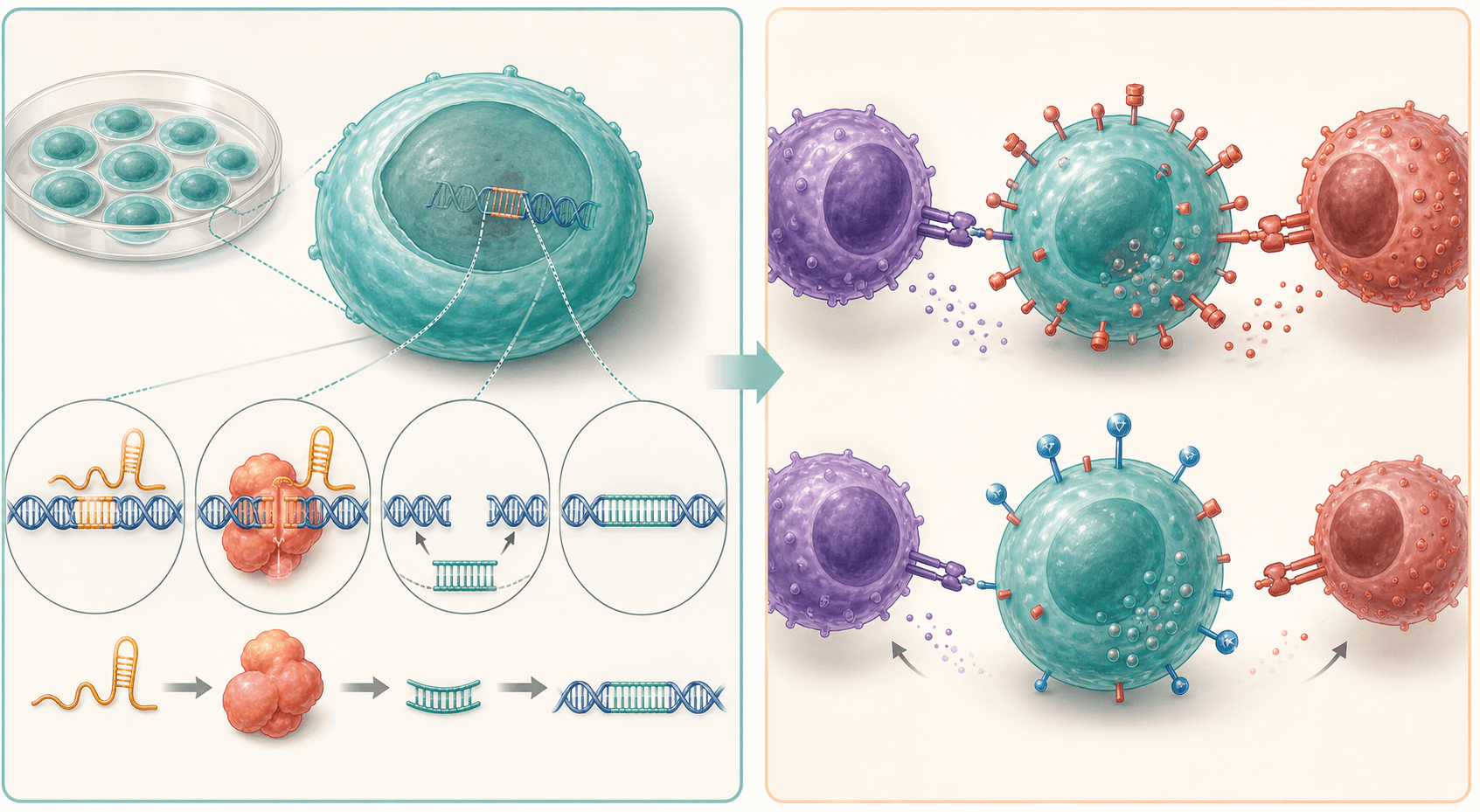
CRISPR systems were adapted from microbial defenses. In the common teaching model, two pieces matter:
- a guide RNA containing a sequence designed to match a DNA target;
- a Cas protein that can cut DNA near that target.
The guide RNA finds a complementary DNA address and brings Cas to it. After the cut, the cell’s own repair machinery reconnects the DNA.
8.2 How a cut becomes an edit
One repair route quickly rejoins broken ends and may introduce small insertions or deletions. Researchers use this to disrupt a gene.
Another route can copy information from a supplied DNA template, allowing a planned sequence change. Newer tools such as base editors or prime editors can make some changes without the classic double-strand break, but they still require careful safety evaluation.
A simplified ex vivo editing workflow
- 1
Choose the biological change and DNA target.
- 2
Design and test a guide RNA.
- 3
Deliver the editing machinery into cultured cells.
- 4
Sequence the intended site and search for unintended changes.
- 5
Reject abnormal cells; expand acceptable cells or clones.
- 6
Differentiate, manufacture, and test the final therapeutic population.
8.3 Why edit cells outside the body?
For T1D replacement, editing is generally ex vivo—outside the body. Researchers can inspect cells before they become a therapy. They can measure whether the intended edit occurred, look for off-target changes, test chromosome stability, and discard unacceptable material.
CRISPR is one step in a cell-manufacturing pipeline
- 1
Choose a DNA target
- 2
Guide Cas protein to that address
- 3
Let the cell repair the cut
- 4
Sequence and screen edited cells
- 5
Expand only acceptable cells
- 6
Differentiate and test the final product
Editing cells directly inside the body would make it harder to control which tissues were changed and impossible to retrieve every incorrectly edited cell. Ex vivo manufacture does not remove risk, but it creates checkpoints.
8.4 The immune-identity problem
Allogeneic cells display HLA molecules inherited from the donor line. Recipient T cells can recognize mismatched HLA and reject the graft. One strategy reduces selected HLA expression.
That creates a new problem. Natural killer (NK) cells are part of innate immunity and can attack stressed cells with unusually low HLA class I. Viruses and tumors sometimes lower HLA to hide from T cells, so NK cells evolved partly to notice “missing self.”
Hypoimmune design therefore balances several signals:
Too visible
Donor HLA and beta-cell antigens can trigger T-cell recognition and graft rejection.
Too hidden
Low HLA can trigger NK cells, while excessive immune evasion could weaken surveillance against dangerous cells.
Researchers may reduce some HLA pathways while adding molecules that send inhibitory signals to innate immune cells. Hypoimmune means reduced immune recognition—not invisibility.
8.5 Editing risk is broader than “wrong address”
An off-target edit is a change at an unintended DNA site. But safety assessment also includes:
- large deletions or rearrangements at the intended site;
- chromosome abnormalities during long cell expansion;
- altered growth or cell identity;
- incomplete editing that leaves mixed populations;
- new immune reactions against the edited product;
- long-term failure of immune surveillance.
Pluripotency and immune evasion create a special combination risk. A cell with abnormal growth potential could be harder for the immune system to remove.
A retrievable implant site can provide another layer of control. Stronger immune evasion raises the importance of monitoring, elimination strategies, and long-term follow-up.
Concept questionWhy doesn’t a clean off-target sequencing result prove the final product is safe?
Explanation
Sequencing addresses only part of the risk. Cells may have large structural changes, altered growth, unstable chromosomes, abnormal differentiation, or immune behavior that a short DNA list does not capture.
Review questions
Review the chapter concepts.
- What jobs do the guide RNA and Cas protein perform?
- Why is ex vivo editing easier to control than editing inside the body?
- Why can reducing HLA class I provoke NK cells?
- What does “hypoimmune” mean—and what does it not mean?
- Name three safety questions beyond ordinary off-target edits.
Use these questions to identify concepts that require additional review.