
9.1 The attractive idea: put cells behind a filter
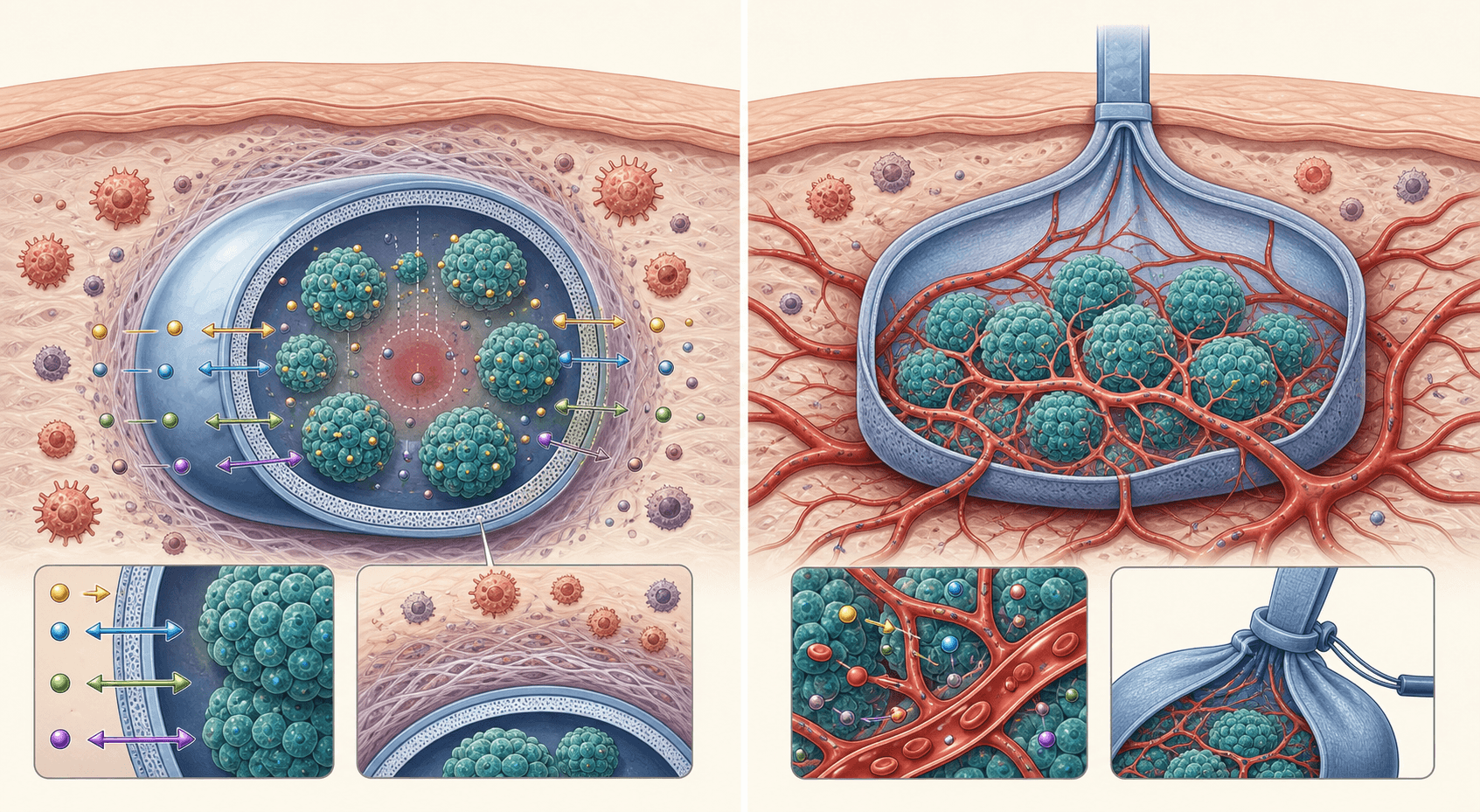
An encapsulation device aims to place therapeutic islet cells behind a semipermeable membrane. Small useful molecules should cross:
- oxygen and nutrients move inward;
- glucose moves inward so cells can sense it;
- insulin and waste products move outward.
Larger immune cells—and perhaps harmful antibodies or complement proteins—should stay outside.
9.2 Diffusion is slow over distance
Diffusion is the random movement of molecules from regions of higher concentration toward lower concentration. It works well across microscopic distances. It becomes inefficient as distance grows.
Native islets solve this with dense capillaries. Most endocrine cells sit close to flowing blood. In a device, there may be no blood vessel inside the cell compartment.
The device trade-off
- 1
Blood carries oxygen and glucose
- 2
Membrane controls what can cross
- 3
Therapeutic cells consume oxygen
- 4
Insulin must diffuse back out
- 5
Fibrosis can thicken the barrier over time
Oxygen is often the hardest constraint because cells consume it continuously and its tissue concentration is limited. Cells near the device surface may survive while cells in the center become hypoxic.
This creates design trade-offs:
More immune isolation
Smaller pores and thicker barriers may block more immune components, but they slow oxygen, glucose, and insulin exchange.
More physiological exchange
Thinner or more open designs improve transport and vascular access, but bring immune components closer to the graft.
9.3 Geometry becomes biology
A thicker device can hold more cells, but increases the maximum distance to oxygen. Smaller compartments shorten diffusion distance, but increase total surface area and surgical complexity.
Cell density matters too. Two devices of the same size may behave differently if one packs twice as many oxygen-consuming cells inside. Materials, shape, dose, and implant site form one system.
Concept questionWhy not simply add many tiny holes so blood vessels can grow inside the device?
Explanation
Vessels would improve oxygen delivery, but blood also carries immune cells, antibodies, and complement. Opening the structure changes the device from a sealed immune barrier into an implant site that needs another form of immune protection.
9.4 The foreign-body response
The body reacts to implanted materials even when they are chemically “biocompatible.” Proteins coat the surface. Macrophages arrive. Fibroblasts can deposit collagen around the implant.
The resulting fibrotic capsule creates an additional barrier outside the engineered membrane. Immune cells may never enter the device, yet oxygen and nutrient transport can still become too poor for the graft.
9.5 What VX-264 taught the field
Vertex’s VX-264 combined stem-cell-derived islet cells with an immunoprotective device intended to avoid chronic systemic immunosuppression. In 2025, the company reported that C-peptide increases were below the level needed for clinical benefit and discontinued the program.
The important conclusion is specific: that implementation did not support enough functioning cell mass. The failure narrows the design space.
9.6 An open, vascularized alternative
Some platforms use a retrievable scaffold or pouch that encourages blood vessels to grow through or around a future cell space. This prioritizes oxygenation and access rather than complete physical immune isolation.
Such a site still requires immune management through systemic drugs, local modulation, or engineered cells, but it may improve function and retrievability. Closed capsules and open vascularized niches address different implantation requirements.
Review questions
Review the chapter concepts.
- Which molecules must cross an encapsulation membrane in each direction?
- Why does oxygen become limiting as distance increases?
- How can fibrosis disable a device without immune cells crossing its membrane?
- What did VX-264 show, and what did it not show?
- Compare a closed capsule with an open vascularized implant niche.
Use these questions to identify concepts that require additional review.