
3.1 The immune system solves a recognition problem
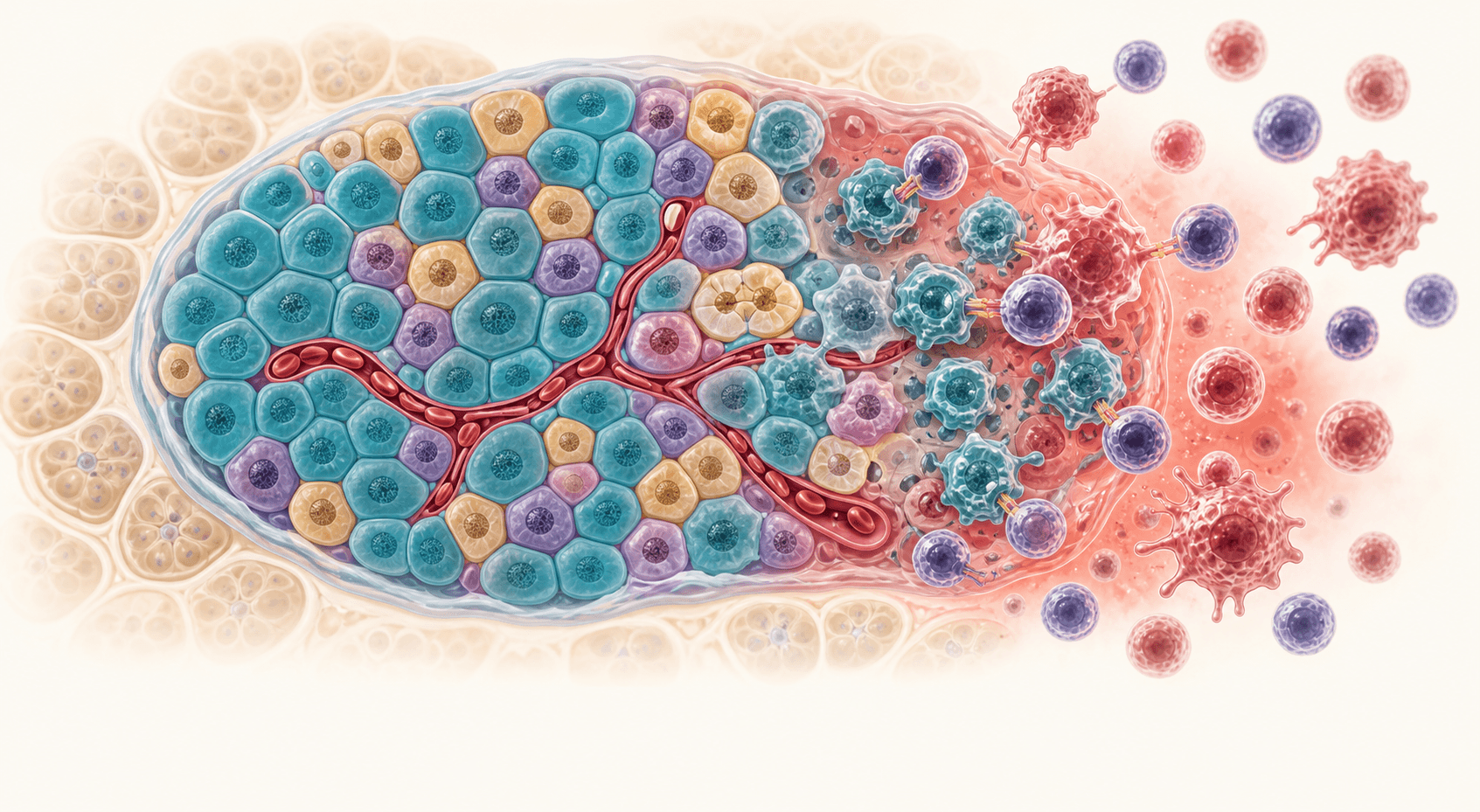
The immune system must respond to pathogens while avoiding destructive responses against the body’s own tissues. Immune cells interpret protein fragments, the context in which those fragments appear, local danger signals, and prior activation history.
Tolerance is the collection of mechanisms that prevents destructive responses against the body. During T-cell development, many strongly self-reactive cells are removed. Other safeguards restrain cells that escape. Regulatory T cells help calm inappropriate responses. Cells also require combinations of signals before launching a full attack.
3.2 Antigens, HLA, and T cells
Cells constantly break proteins into short fragments. Molecules called HLA hold some fragments at the cell surface so T cells can inspect them. This is called antigen presentation.
An antigen is anything an immune receptor can specifically recognize. It is not automatically a germ. Insulin and other beta-cell proteins can become autoimmune antigens.
Certain inherited HLA variants make type 1 diabetes more likely because they present particular beta-cell fragments in ways that can favor harmful immune recognition. HLA genes influence risk; they do not determine destiny. Most people with risk-associated genes do not develop T1D.
Several immune cell types take part:
- CD4 T cells coordinate and sustain immune responses.
- CD8 T cells can directly kill stressed or targeted beta cells.
- B cells make antibodies and can present antigens to T cells.
- Innate immune cells release inflammatory signals and shape the local environment.
- Regulatory T cells normally help restrain excessive or self-directed responses.
The disease is therefore not one rogue antibody or one type of cell acting alone. It is a network.
3.3 Autoantibodies are smoke alarms
Many people developing T1D produce antibodies against insulin, GAD65, IA-2, ZnT8, or other islet-associated targets. Persistent multiple islet autoantibodies strongly predict progression.
Autoantibodies are extremely useful because a blood test can detect them before symptoms. But they are better thought of as signposts of an autoimmune process than as a complete account of beta-cell killing.
Biomarker
A measurable sign associated with a biological process. It can predict disease even if it is not the main cause.
Mechanism
The chain of events that actually produces damage or benefit. In T1D, T-cell-mediated processes are central.
Removing one antibody does not necessarily erase the B cells, T cells, tissue inflammation, and immune memory that produced it. This is why a trial can change an immune marker without producing enough clinical benefit.
3.4 The three stages of type 1 diabetes
Modern staging begins before symptoms:
How a silent process becomes symptoms
- 1
Genetic susceptibility
- 2
Loss of immune tolerance
- 3
Islet autoantibodies appear
- 4
Beta-cell reserve shrinks
- 5
Glucose control begins to fail
- 6
Stage 3 symptoms appear
Stage 1 means two or more persistent islet autoantibodies are present, but glucose regulation is still normal. Autoimmunity exists, yet remaining beta-cell reserve is sufficient.
Stage 2 means autoantibodies plus dysglycemia—measurable abnormalities in glucose regulation—but no classic symptomatic diabetes yet. The controller is beginning to fail under testing.
Stage 3 is clinical T1D. Beta-cell function is no longer sufficient to keep glucose controlled. Symptoms can include thirst, frequent urination, weight loss, fatigue, blurred vision, and, in dangerous cases, diabetic ketoacidosis.
Concept questionWhy can someone feel healthy during stages 1 and 2?
Explanation
The body has reserve. Remaining beta cells can increase their work, and ordinary life may not expose the deficit immediately. Symptoms appear late in the biological process, when compensation is no longer enough.
3.5 What actually makes beta cells disappear?
A simplified historical model presented T1D as a linear process in which immune attack begins, beta-cell mass steadily falls to zero, and symptoms then appear. Observed disease trajectories are more variable.
The process can speed up, slow down, or plateau. Beta cells can become stressed and function poorly before dying. Inflammation may be patchy across the pancreas. Age, infection history, genes, metabolic demand, and immune phenotype all shape the trajectory. Some people retain measurable C-peptide for years after diagnosis.
This matters because therapy depends on timing:
- Before major loss, immune therapy may preserve a meaningful working cell population.
- Near diagnosis, immune therapy may prolong the “honeymoon” of residual secretion.
- In long-standing T1D, stopping attack alone cannot reliably manufacture the missing cell mass.
Review questions
Review the chapter concepts.
- Why does immune tolerance require several safeguards rather than one self-identification tag?
- What do HLA molecules do?
- Why can autoantibodies predict disease without being the whole destructive mechanism?
- Explain the difference among stage 1, stage 2, and stage 3 T1D.
- Why should the same immune therapy have different effects before diagnosis and after decades of disease?
Use these questions to identify concepts that require additional review.